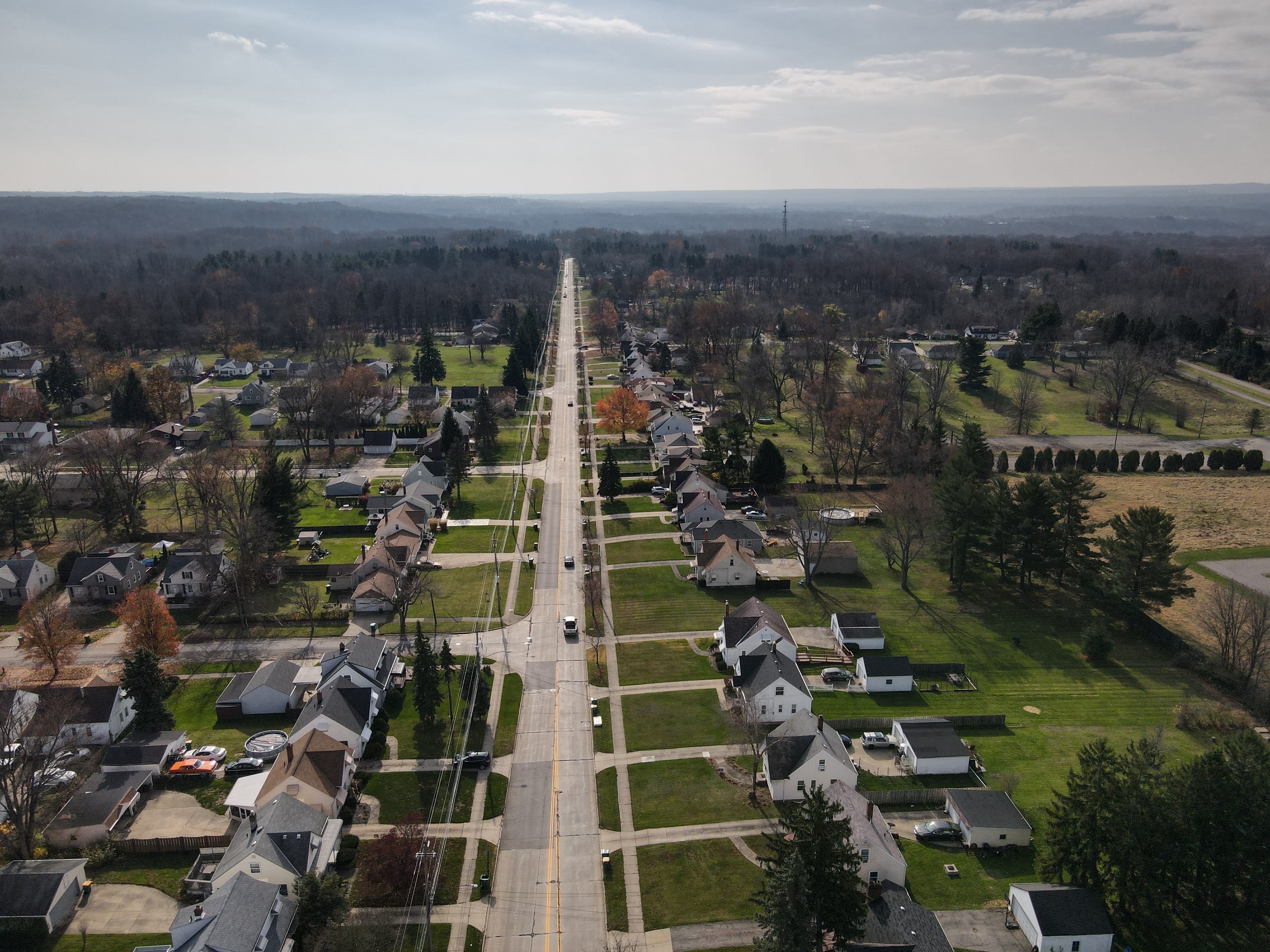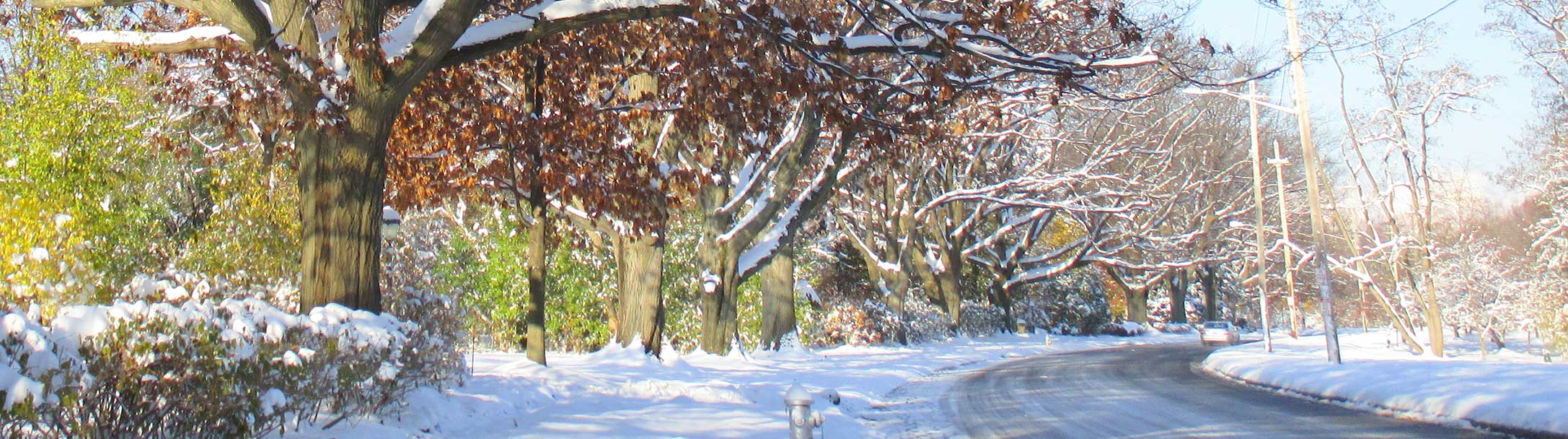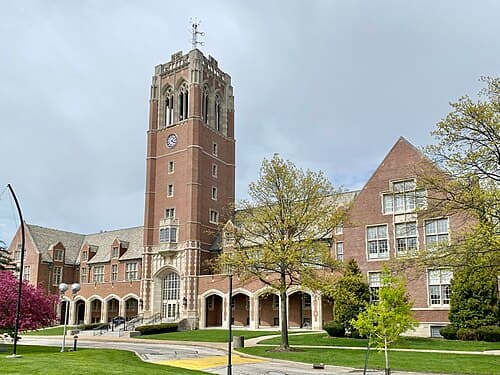
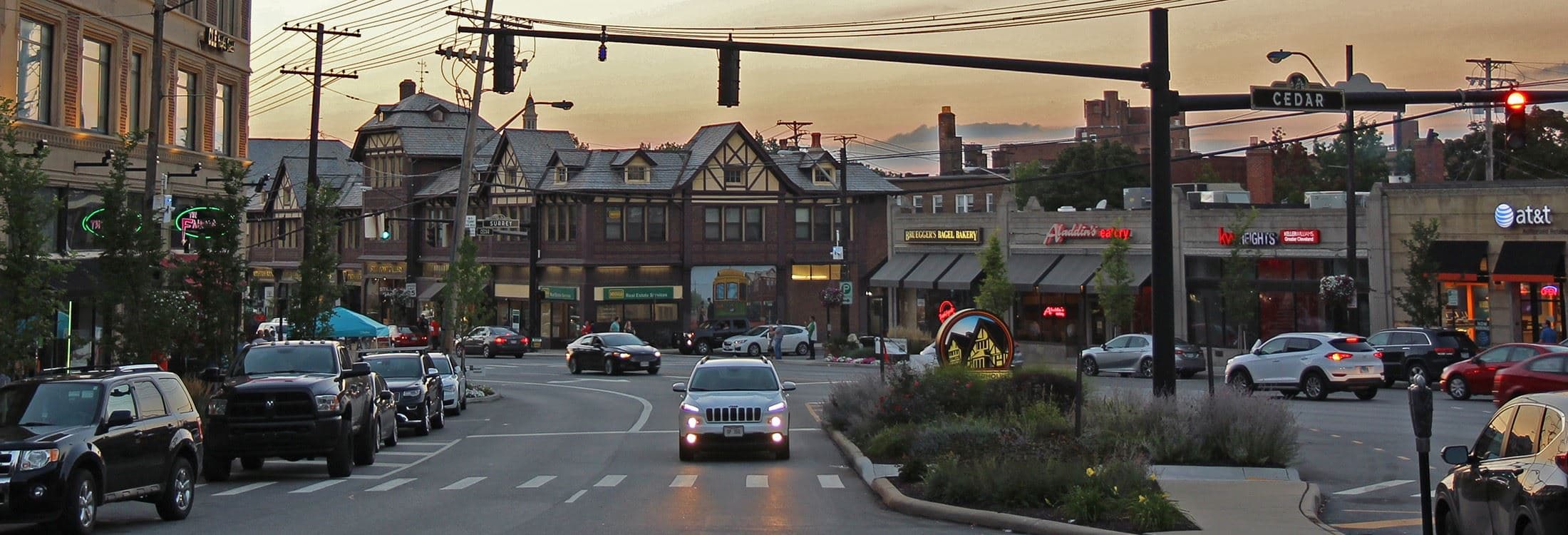
There are a handful of Cleveland suburbs that feel less like suburbs and more like fully formed small cities with their own personalities, and Cleveland Heights is at the top of that list. Drive east out of University Circle, climb the hill past Lake View Cemetery, and within a few minutes you're under a canopy of mature trees, passing brick Tudors, Colonial Revivals, and bustling sidewalks where someone is always walking a dog, pushing a stroller, or carrying a Tommy's takeout bag.
For more than a century, the Heights has attracted people who want walkable streets, real architecture, good schools, and neighbors who actually know each other — and it still does in 2026. It's also a city in the middle of a genuinely interesting moment: a new mayor, a freshly doubled road-repair budget, and the kind of civic energy you only get in places where residents care a lot about where they live.
If you're considering a move to the east side, here's what we tell families who ask us about Cleveland Heights — the good, the practical, and the things that make it different from anywhere else in Greater Cleveland.
The basics
Cleveland Heights sits directly east of the City of Cleveland, just up the hill from University Circle and the museums, hospitals, and Case Western Reserve University. The city has a population of roughly 45,000, making it one of the largest inner-ring suburbs in Cuyahoga County. Downtown Cleveland is a 15–20 minute drive depending on traffic and which corner of the Heights you live in, and the Cleveland Clinic and University Hospitals campuses are even closer — often a 5–10 minute commute.
Most addresses fall into one of four ZIP codes: 44106 (the western edge, near Little Italy and University Circle), 44112 (the Forest Hill area near East Cleveland), 44118 (the largest, covering most of the central city including Coventry and Cedar Lee), and 44121 (the northern and eastern sections near South Euclid).
Public school families are served by the Cleveland Heights-University Heights City School District, one district that covers both cities. The housing stock is overwhelmingly prewar — most of the city was built out between roughly 1910 and 1940 — which means brick, plaster, hardwood, leaded glass, and the kind of detail you simply cannot build new today.
A short history
Cleveland Heights began as a streetcar suburb in the late 19th and early 20th centuries, when wealthy Clevelanders started moving up the hill to escape the smoke and noise of the industrial flats. The village incorporated in 1903 and officially became a city in 1921 as its population exploded past the threshold during one of the most aggressive building booms in Northeast Ohio history.
The single most famous resident was John D. Rockefeller, who used the Forest Hill estate — straddling what is now Cleveland Heights and East Cleveland — as his summer home for decades. After the original mansion burned in 1917, his son John D. Rockefeller, Jr. purchased the estate in 1923 and eventually developed the surrounding land into the Forest Hill residential district, a planned neighborhood of distinctive English-style stone-and-slate homes that you can still walk through today. The remaining parkland became Forest Hill Park, shared between Cleveland Heights and East Cleveland.
Meanwhile, developers like Grant Deming and the Van Sweringen brothers were laying out the streets that define the city's character: curving boulevards, generous lots, and an extraordinary concentration of Tudor Revival and Colonial Revival homes. The city's own history and architecture page is a great rabbit hole if you like that sort of thing — and most Heights homeowners eventually do.
Schools
The Cleveland Heights-University Heights City School District serves both cities with a network of elementary and middle schools that feed into a single comprehensive high school: Cleveland Heights High School, universally known as "Heights High."
The high school building itself is part of the story. After a multi-year bond-funded renovation, the district reopened a fully renovated Heights High in August 2017, preserving the historic 1926 façade while modernizing classrooms, athletics, and performance spaces. Heights High has long been known for strong arts and music programs, a competitive swim program, and one of the more diverse student bodies in the region.
The district is also home to a number of private and parochial alternatives nearby — Ruffing Montessori, Hathaway Brown, Laurel, and University School are all within easy reach — so families considering the Heights typically have options to weigh.
Parks & outdoors
For a city of its size, Cleveland Heights has a remarkable amount of green space.
Cain Park is the crown jewel — a city-owned performing arts park built into a wooded ravine in the 1930s under the direction of Heights High drama teacher Dr. Dina Rees Evans. Today it includes the open-air Evans Amphitheater, the covered Alma Theater, an art gallery, and one of the most beloved summer concert and arts-festival schedules in Northeast Ohio. Recent ADA access and tiered seating upgrades have made the venue easier to enjoy for everyone.
Forest Hill Park, the former Rockefeller estate, offers 235 acres of trails, ponds, tennis courts, and one of the best sledding hills on the east side. Cumberland Park near Cedar Lee is the family hub — a pool, splash pad, playground, skate park, and ball fields all in one walkable spot. Add in Denison, Caledonia, and Forest Hill's neighbor Lake View Cemetery (yes, locals treat it as a park, and yes, it's spectacular), and you've got a city where you genuinely don't need to drive to find trees.
Coventry, Cedar Lee & the local culture
Cleveland Heights has two distinct walkable commercial districts that anchor the city's identity, and locals tend to have strong feelings about both.
Coventry Village is the legendary one — a bohemian, slightly countercultural strip that has been the east side's unofficial weird-and-wonderful headquarters since the 1960s. Vintage shops, the long-running Mac's Backs bookstore, Big Fun's successor businesses, and a Coventry Street Fair tradition that still draws crowds. It's the kind of place where the tattoo parlor, the toy store, and the synagogue are all on the same block.
Cedar Lee is the slightly more grown-up sibling — a one-mile commercial stretch along Lee Road with more than 100 small businesses, anchored by the Cedar Lee Theatre, an independent cinema that's been showing films since 1925 and remains the go-to spot in town for indie, foreign, and arthouse releases.
Between the two districts, you also get easy access to Severance Town Center, the Coventry P.E.A.C.E. Park, and a calendar full of street fairs, art walks, and farmers markets that genuinely fill up every weekend from May through October.
Where to eat & shop
Asking a Heights resident for their favorite restaurant is a great way to start a long conversation. A few institutions:
- Tommy's on Coventry — open since 1972, famous for milkshakes, falafel, and a menu that somehow satisfies vegans, gluten-free eaters, and unrepentant carnivores at the same table. A genuine Cleveland landmark.
- Mad Greek at Cedar and Fairmount — a Heights staple for decades, where Greek and Indian dishes share one improbable, beloved menu.
- The Fairmount, Mia Bella, Anatolia Cafe, Pacific East, Boss Dog Brewing, Stone Oven, Phoenix Coffee, and Inn on Coventry all show up on local lists with regularity.
- For groceries: Heinen's at Cedar Center, Zagara's Marketplace, and a strong rotation of farmers markets in the warmer months.
You can eat your way across the city without ever stepping into a chain restaurant, and most longtime residents basically do.
Recent news & what's changing
A few things to know if you've been reading Cleveland Heights headlines lately.
A new mayor. Cleveland Heights had a genuinely turbulent 2025. After a series of controversies, voters recalled the city's first elected mayor, Kahlil Seren, in September 2025. In November, City Council member Jim Petras was elected mayor over Davida Russell, and the city has spent the early part of 2026 visibly trying to turn the page.
Roads. One of the most concrete signs of that reset: in 2026 the city more than doubled its road-resurfacing budget from about $2.44 million in 2025 to $5.1 million, with an initial $3.3 million contract expanding the annual paving list from 11 streets to 27 streets this year. If potholes have been a sore spot for you in the Heights, 2026 is the year to watch.
Ranked-choice voting. Cleveland Heights had been one of the most-watched cities in Ohio for a possible local ranked-choice voting ballot measure. In May 2026, City Council pulled its support for putting RCV on the November ballot, citing the cost and risk of litigation under recent state penalties. Supporters can still pursue a citizen-led ballot initiative — it's a story that isn't fully over.
Who Cleveland Heights is for
Cleveland Heights is a great fit if you:
- Want a prewar home with character — original woodwork, built-ins, leaded glass, real plaster — and don't mind that "character" sometimes means a quirky basement.
- Value walkability. Few Cleveland suburbs let you walk to a coffee shop, a bookstore, a theater, and a park as easily.
- Have school-age kids and like the idea of a diverse, urban-feeling district rather than a more homogeneous outer-ring one.
- Work at University Hospitals, the Cleveland Clinic, Case Western, or downtown and want a short, predictable commute.
- Like a city with strong civic engagement — for better and occasionally for messier — where people show up to council meetings and care about what happens next.
It's probably not the right fit if you specifically want new construction, an HOA-managed subdivision, or a very low-tax suburb. Inner-ring services and older infrastructure come with inner-ring tax rates, and that tradeoff is real.
Looking for a Cleveland Heights home?
At Milton PM, we manage family rentals throughout the east side, and Cleveland Heights is one of the neighborhoods we know best — block by block, school by school, and yes, pothole by pothole (though hopefully fewer of those by year's end). Whether you're a family relocating for one of the hospitals, a Case grad staying in town, or a long-time Clevelander finally moving up the hill, we can help you figure out which pocket of the Heights actually fits how you live.
See our Cleveland Heights listings →
Questions about a specific street, school boundary, or property? Contact our team — we're happy to talk through it.
Looking for a home in Greater Cleveland?
Milton PM manages quality family homes across Cleveland, Maple Heights, Garfield Heights, Cleveland Heights and surrounding communities. Get in touch with a real, local team.